
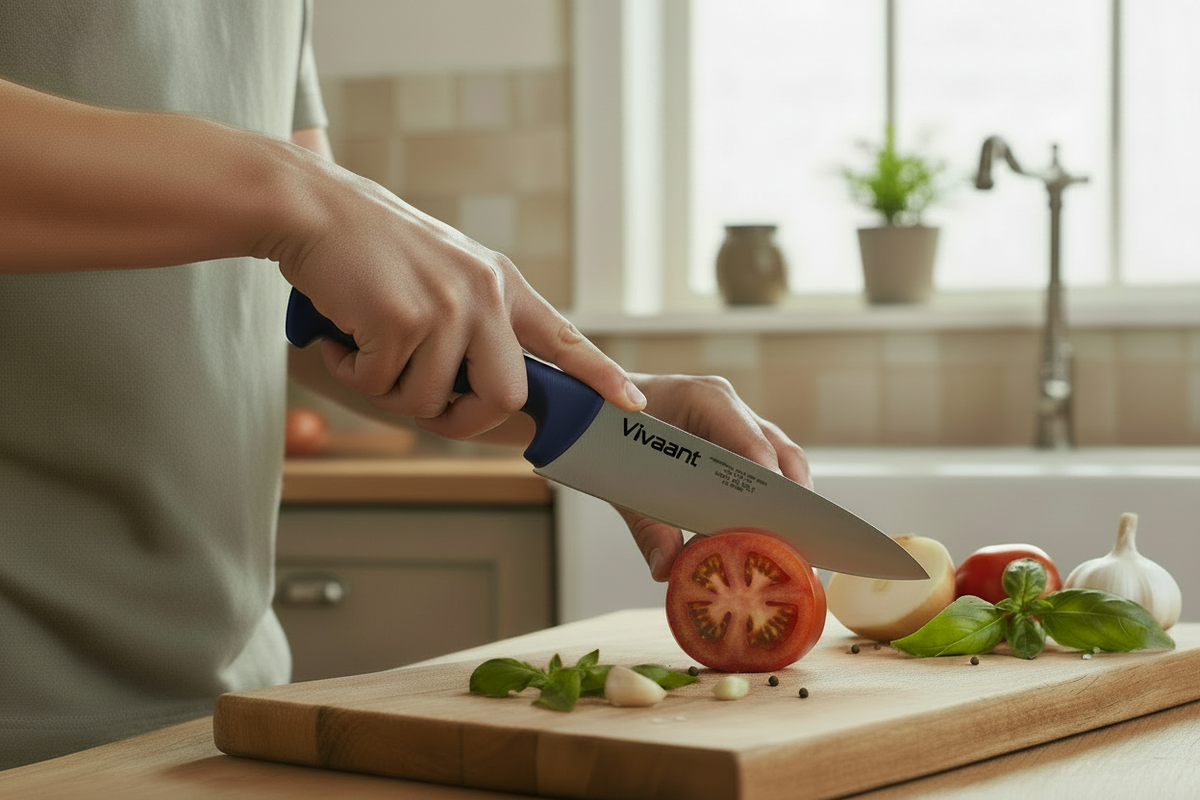
A good chef knife does not need a drawer full of competition. For most everyday cooking, an 8-inch blade can handle the jobs that appear again and again: chopping onions, slicing vegetables, mincing herbs, portioning meat, and turning a pile of ingredients into dinner.
The 8-inch chef knife is popular because it balances reach with control. It is long enough to move through larger foods, but compact enough for the quick prep tasks home cooks tackle every day.
What makes an 8-inch chef knife so useful?
Blade length affects both cutting capacity and maneuverability. A shorter knife can feel nimble but may require extra strokes on large ingredients. A longer knife offers more reach but can feel unwieldy on a small cutting board. Eight inches sits comfortably between the two.
That middle-ground size works well for:
- Chopping onions, carrots, celery, and peppers
- Slicing tomatoes, squash, cabbage, and potatoes
- Mincing garlic and fresh herbs
- Dicing fruit and vegetables
- Portioning boneless meat and poultry
- Rocking through piles of herbs or aromatics
The blade material matters
The Vivaant 8-Inch Italian-Made Chef Knife uses restaurant-grade X50CrMo14 high-carbon stainless steel. This type of steel combines the cutting performance cooks want with the corrosion resistance that makes everyday care more manageable.
A sharp, sturdy blade needs less force than a dull one. That makes slicing feel smoother and gives you better control. The polished satin finish also gives the knife a clean, professional look without making it too precious for Tuesday-night onions.
Comfort is more important than it sounds
A knife can have excellent steel and still be unpleasant to use if the handle feels awkward. The Vivaant chef knife has an ergonomic TPE handle with a non-slip grip designed to reduce fatigue, including when the handle is wet.
For safer, more comfortable cutting, hold the knife securely and keep your wrist in a natural position. Many cooks use a pinch grip, lightly pinching the blade near the handle with the thumb and index finger while the remaining fingers wrap around the handle. Use whichever secure grip gives you the best control.
Three core cuts to practice
The slice
Move the blade forward and down through the food in a smooth motion. Slicing works well for tomatoes, cucumbers, meat, and fruit. Let the sharp edge do the work instead of pressing down with excessive force.
The chop
Lift the blade and bring it down in controlled, even strokes. Keep the food stable and curl the fingertips of your guiding hand inward, using the knuckles as a guide while keeping fingertips away from the edge.
The rocking mince
Keep the tip of the knife near the board while lifting and lowering the heel in a rocking motion. This technique is useful for herbs and garlic. Work slowly until the movement feels controlled.
Use the right cutting surface
A stable wood or quality plastic cutting board is kinder to the edge than glass, stone, ceramic, or metal. Place a damp towel or nonslip mat under the board if it moves. A secure board and sharp knife are a much better team than a sliding board and heroic reflexes.
Italian craftsmanship for everyday cooking
This knife is authentically made in Italy for both home and professional cooks. Its high-carbon stainless steel blade, satin finish, and comfort grip are practical features, not decoration. The point is to make repetitive prep feel easier and more controlled.
It is also backed by Vivaant’s lifetime warranty and customer service. That matters for a tool intended to earn a permanent place in your kitchen rather than make a brief appearance before disappearing into the gadget drawer.
One knife, a lot of dinner
An 8-inch chef knife cannot replace every specialty blade, but it can cover a remarkable share of daily prep. Start with a stable board, a secure grip, and ingredients that are positioned safely. Keep the edge sharp, let the blade do the work, and focus on smooth, controlled movements rather than speed.
Speed arrives with practice. Dinner, thankfully, does not require a stopwatch.
Share:
How to Chop Vegetables Faster Without a Food Processor